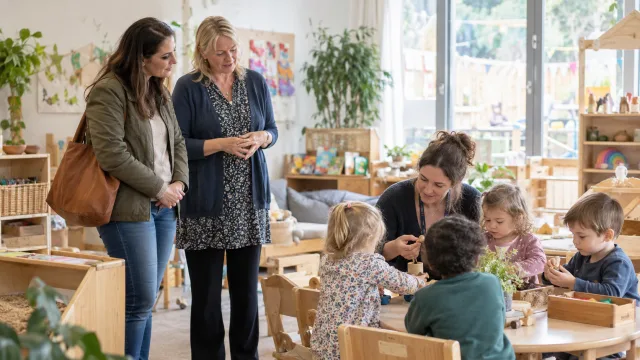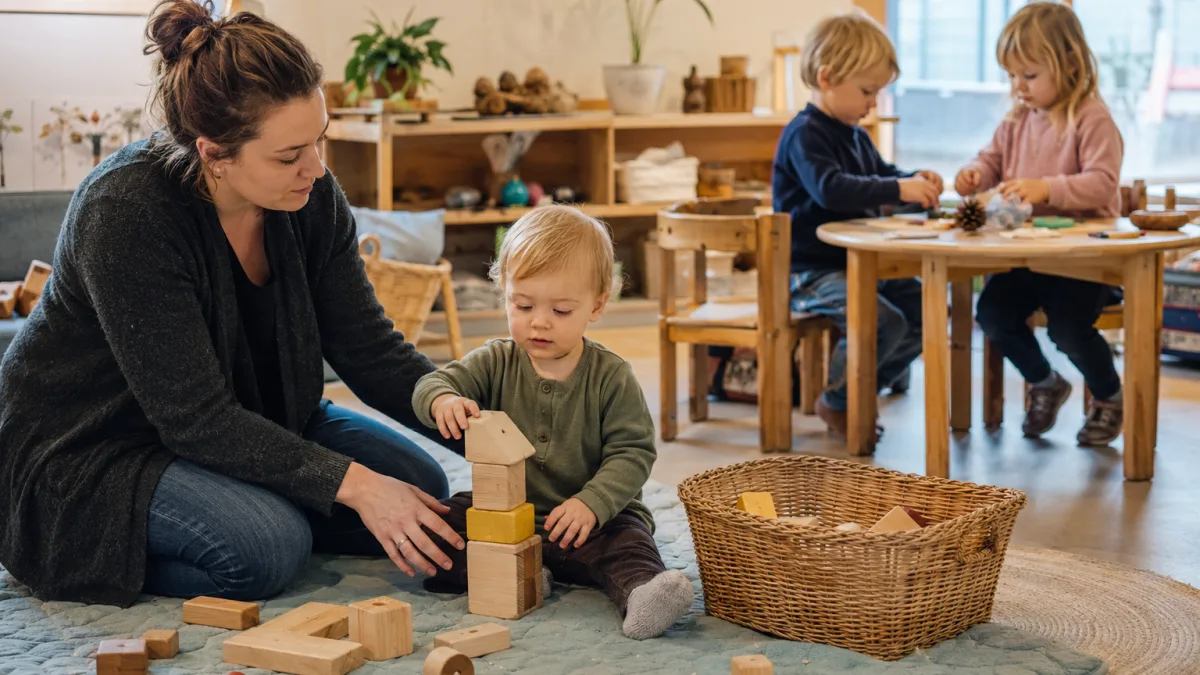
Nursery and preschool are often presented as two clearly different types of childcare. In practice, the distinction is much less tidy.
A nursery may have a preschool room for its oldest children. An independent preschool may provide a similar learning experience but operate for shorter, term-time sessions. A primary school may have a nursery class that local families casually call “preschool”. Some providers even use both words in their name.
The most common practical difference is that a day nursery usually offers longer childcare for a wider age range, while a preschool commonly focuses on children aged two to four and may follow school-style hours and terms. However, the name alone does not tell you what a particular setting provides.
Parents therefore need to compare the actual hours, costs, age groups, routines and care offered rather than assuming that one label will be better for their child.
Nursery vs preschool at a glance
| Feature | Day nursery | Preschool |
|---|---|---|
| Typical age range | Babies through to school age | Usually children aged two or three to school age |
| Common opening hours | Full working day, often Monday to Friday | Shorter morning, afternoon or school-day sessions |
| Opening year | Often most of the year | Often term time, although this varies |
| Main purpose | Early education combined with childcare | Early education and preparation for school |
| Meals and personal care | Commonly includes meals, naps and full-day care | Depends on session length and provider |
| Funded hours | May offer funded places, sometimes with additional paid hours | May offer funded sessions, often during term time |
| Location | Purpose-built or converted childcare premises, workplaces or community locations | Community halls, dedicated premises or schools |
These are common patterns, not rules. A preschool may be open from early morning until late afternoon, and a nursery may accept only children from age two. Always check the individual provider’s arrangements.
What is a nursery?
The word “nursery” can describe several different forms of early years provision.
A private day nursery commonly accepts babies, toddlers and preschool-aged children. It may open for around ten or more hours each weekday and operate for most of the year, closing only for weekends, bank holidays and a short period over Christmas.
Children are usually divided into rooms or groups according to their age and development. A larger nursery might have a baby room, toddler room and preschool room. Moving into the preschool room does not necessarily mean changing provider; it may simply be the next stage within the same nursery.
Day nurseries are designed to provide both care and early education. Their longer days may include breakfast, lunch, tea, snacks, sleep, personal care, outdoor play and a variety of child-led and adult-guided experiences.
“Nursery” can also mean a maintained nursery school or a nursery class attached to a primary school. These usually focus on children approaching school age and may operate during school terms. Their admissions and attendance arrangements can be very different from those of a private day nursery.
This is why parents should not assume that every nursery accepts babies or provides full-day, year-round care.
What is a preschool?
A preschool usually provides early education for children during the period before they start Reception. Many accept children from age two or three, although the exact starting age varies.
Preschools have historically also been called playgroups. Some developed from parent-led community groups and continue to operate as charities or voluntary organisations. Others are privately owned or form part of a nursery, school or larger childcare organisation.
A preschool may offer morning and afternoon sessions rather than full-day care. For example, it might run from 9am until midday and again from 12.30pm until 3.30pm during school terms.
Other preschools provide a school-length day, lunch clubs or extended sessions. A setting calling itself a preschool could therefore offer anything from a few mornings each week to care covering much of the working day.
The word often suggests a stronger focus on preparation for school, but this should not be interpreted as formal classroom teaching. Good early years education is primarily based on relationships, communication, exploration and play.
Do nurseries and preschools follow different curriculums?
In England, registered early years providers caring for children from birth to five generally work within the Early Years Foundation Stage, commonly known as the EYFS.
This means that a nursery and a preschool are not necessarily following competing curriculums. Both may support learning across communication and language, physical development, personal, social and emotional development, literacy, mathematics, understanding the world and expressive arts and design.
The way this looks in practice should remain suitable for young children. Learning might happen while children build with blocks, listen to stories, mix mud in an outdoor kitchen, take turns in imaginative play or talk about the insects they discover in the garden.
A preschool does not become more educational simply because children sit at tables for longer or complete more worksheets. Equally, a nursery is not providing “only childcare” because it cares for babies or offers long days.
Children learn throughout everyday routines. Serving food can develop independence and conversation. Getting dressed for the garden involves physical skills and problem-solving. Comforting another child supports empathy and relationships.
When comparing settings, ask how practitioners plan from children’s interests, notice development and support each child. The provider’s approach matters more than whether its sign says nursery or preschool.
How do the hours and annual calendars differ?
Opening hours are often the most important practical difference.
A day nursery is commonly designed around parents’ working days. It may open at 7.30am or 8am and close at 6pm or later. Families may book full days, shorter sessions or a combination, depending on the provider.
Many day nurseries operate for 50 or 51 weeks of the year. This can help parents who work during school holidays, although fees may be payable throughout the year.
Preschools are more likely to follow the school calendar and open for approximately 38 weeks. Sessions may align with the local school day, making them convenient for families with older children at a nearby school.
Term-time provision can also mean that parents need another arrangement during half terms, Easter, summer and other school holidays. Before accepting a place, calculate how those closures would affect your work and childcare budget.
Do not rely on descriptions such as “full day” or “morning session”. One provider’s full day might be 8am to 6pm, while another’s is 9am to 3pm. Ask for exact drop-off and collection times.
Which option is more suitable for working parents?
A full-day nursery is often easier for parents who need regular childcare across the working week and during school holidays. Longer opening hours can accommodate commuting, shifts and a standard office day more readily than a sessional preschool.
However, suitability depends on the family’s real schedule. A term-time preschool may work very well where a parent works school hours, receives help from relatives or can combine preschool with a childminder.
Some parents use more than one form of childcare. A child might attend preschool for several sessions and spend the rest of the week with a childminder or family member. This can offer flexibility, but it also creates additional journeys and transitions.
Ask whether the setting requires a minimum number of sessions or fixed attendance days. A nursery may provide long hours but insist on two complete days each week. A preschool may allow individual sessions but have limited availability on popular mornings.
Also consider what happens if you arrive late. A preschool that closes at 3.30pm may have no staff or provision after that time, whereas a day nursery may offer a wider collection window within the booked session.
How do fees and funded hours work?
Neither nursery nor preschool automatically means free or paid childcare. Both types of setting may offer funded early education places, charge private fees or combine funded hours with paid services.
In England, eligible working families may receive funded childcare from the age of nine months until their child starts school. All three- and four-year-olds can receive the universal entitlement, while some two-year-olds qualify for a separate entitlement based on family or child circumstances.
Our guide to funded childcare hours and who can receive them explains the main eligibility rules and application process.
The way funding is offered can differ considerably between providers. A term-time preschool may allow a family to use funded hours across its ordinary weekly sessions. A year-round nursery may stretch the annual entitlement across more weeks, resulting in fewer funded hours during an average week.
A setting may also charge separately for:
- Hours outside the funded sessions
- Meals and snacks
- Nappies or other consumables
- Optional activities or outings
- Registration or administration
- Late collection
Ask for a written cost illustration based on your child’s age, attendance days and expected funding. A headline such as “30 hours accepted” does not reveal what the family’s actual monthly bill will be.
Compare annual rather than weekly costs. A preschool may appear cheaper during term time but require families to purchase separate holiday care. A nursery may charge more each month but cover almost the whole year.
Are preschools more focused on school readiness?
Preschools often describe school readiness as an important part of their work, particularly because most of their children are approaching Reception age.
A nursery’s preschool room should also help children prepare for the transition. The difference may be less substantial than the names suggest.
School readiness should not mean expecting a four-year-old to reproduce the routines of an older primary school pupil. Useful preparation includes helping children to:
- Separate from their parent or carer with appropriate support
- Communicate their needs
- Build relationships with adults and other children
- Listen and participate in a group
- Use the toilet and manage clothing with growing independence
- Recognise and care for their belongings
- Eat, drink and wash their hands with less assistance
- Cope with small changes and unfamiliar experiences
- Become curious about stories, language, numbers and the world
These skills can be developed in a day nursery, preschool, childminding setting or at home. Ask how the provider supports independence and emotional confidence rather than concentrating only on letters and numbers.
It is also useful to ask how the setting communicates with local primary schools and supports children during the move to Reception.
What are the differences in routine and atmosphere?
A day nursery often has a longer and more flexible daily rhythm because children may arrive and leave at different times. Breakfast, sleep and tea may form part of the day, and younger children may follow individual feeding and resting routines.
A sessional preschool may have a more defined beginning and end. Most children may arrive together, take part in the same broad period of activities and leave after lunch or at the end of the school day.
Neither pattern is inherently better. Some children enjoy the continuity and smaller time boundary of a preschool session. Others benefit from an unhurried full day in one familiar place rather than moving between several carers.
Atmosphere varies more between individual settings than between provider types. One nursery may feel busy and energetic, while another has small rooms and a quiet pace. A community preschool may have a large mixed-age group, while another organises children into smaller key-person groups.
Visit while children are present, if possible. Notice how adults respond when a child needs help, how much time children have to develop their own play and whether the environment feels warm as well as organised.
Do nurseries and preschools have different staff?
Both should have practitioners with appropriate knowledge, experience and qualifications for the children they care for. They must also meet the staffing and safeguarding requirements applying to their type of provision.
A day nursery caring for babies will need staff who understand feeding, sleep, attachment, nappy changing and the development of very young children. Its team may be divided between several age-based rooms.
A preschool team may have particular experience of supporting children aged two to four, including language development, independence and transition to school.
School nursery classes may employ a teacher and early years support staff, although arrangements vary. A private nursery or independent preschool may also employ qualified teachers, early years teachers or practitioners with graduate-level training.
A job title alone does not show the quality of a child’s experience. Parents should consider:
- How warmly staff interact with children
- Whether practitioners know individual children well
- How the key-person arrangement works
- How stable the staff team appears
- How absences and changes are managed
- Whether staff receive relevant training
- How information is shared with families
Ask who would be primarily responsible for your child and when you are likely to meet that person.
Is a school nursery the same as a preschool?
A nursery class or nursery school can provide a preschool-age child with early education before Reception, but its organisation may be different from that of an independent preschool.
Being attached to a primary school does not usually guarantee a Reception place at that school. Nursery and Reception admissions may be handled separately, with different criteria and application processes.
Parents should check this carefully rather than assuming that nursery attendance provides priority. Ask the school and consult the local authority’s current admission arrangements.
A school nursery may offer morning, afternoon or school-day places during term time. Wraparound care may be available through the school or another provider, but it should not be assumed.
School-based provision can make the eventual move into Reception feel familiar. The child may already know the building, outdoor areas and some members of staff. However, a child coming from another high-quality setting can also make a successful transition with suitable support.
The most suitable choice remains the one that provides good care, meets the child’s needs and works for the family—not simply the one located closest to a preferred Reception classroom.
How should parents compare a nursery and preschool?
Begin with the practical requirements that cannot easily be compromised. These may include opening hours, distance, availability, age range, holiday provision and affordability.
Once both options appear workable, compare the child’s likely experience. Useful questions include:
- Who will be my child’s key person?
- How do you help new children settle?
- What does an ordinary day look like?
- How much uninterrupted play do children have?
- How often can children use the outdoor space?
- How do you respond when a child is upset?
- How are naps, meals and personal care managed?
- How do you support children with additional needs?
- How will you share information with us?
- Which hours and additional costs are not covered by funding?
- What happens during school holidays?
Read the latest inspection information, but do not use a judgement as the only measure of suitability. Inspection dates, leadership and staff teams can change, and two families may value different qualities in a setting.
The provider’s website can help with the first stage of research. Our article on what parents look for first on a nursery website covers the details a useful site should make easy to find.
A visit is still important. Observe interactions rather than concentrating only on displays, equipment and the appearance of the building. A modest room with attentive practitioners may offer a much stronger experience than an impressive environment in which adults appear distant or rushed.
Which is better: nursery or preschool?
Neither is automatically better. The quality of the individual setting and its suitability for the child matter much more than the name.
A day nursery may be the stronger choice if you need:
- Care from babyhood until school
- Long working-day hours
- Provision during most school holidays
- Meals, naps and personal care within one setting
- Continuity without changing provider at age three
A preschool may be especially suitable if you want:
- Shorter or school-day sessions
- Term-time early education
- A setting primarily focused on children approaching school age
- A community or school-based environment
- Sessions that fit around an older child’s school day
Those advantages are only relevant if the particular provider genuinely offers them. Check its current arrangements rather than choosing according to the category.
Think about your child as an individual too. A child who needs time to become comfortable may benefit from staying at a familiar nursery rather than moving to a new preschool simply because they have reached a certain age. Another child may be ready for a shorter, more age-focused setting close to their future school.
Frequently asked questions
Is preschool compulsory in the UK?
No. Children do not have to attend a preschool or nursery before starting school. Many families choose early years provision because it offers childcare, social experiences and opportunities for learning, but attendance itself is not compulsory.
What age does preschool start?
Many preschools accept children from age two or three, but there is no single starting age used by every provider. Some accept younger children, while others offer places only from the funding period after a child’s third birthday.
Can babies attend preschool?
Most settings described as preschools focus on children aged two or above and do not have baby provision. A day nursery is more likely to accept babies, but parents should always check the provider’s registered age range.
Does nursery continue until Reception?
Many day nurseries care for children until they start Reception and have a preschool room for the oldest group. Other nurseries offer only particular age ranges, so confirm when provision ends.
Is preschool more educational than nursery?
Not necessarily. Nurseries and preschools in England may both follow the EYFS and provide early education through play, relationships and everyday experiences. The provider’s practice is more important than its name.
Is a school nursery free?
A child may be able to use funded hours in a school nursery, but this does not mean every possible session or related service is free. Ask which hours are funded and whether charges apply for meals, extended care or other provision.
Can funded hours be used at either type of setting?
Funded hours can be used with participating approved providers, which may include day nurseries, preschools and school nurseries. Availability and the way hours are scheduled vary between settings.
Can a child attend both nursery and preschool?
Yes, if the arrangements are manageable and both providers have suitable places. Funded hours may sometimes be divided between settings, but the total claimed cannot exceed the child’s entitlement. Parents should ensure both providers know about the arrangement.
Will attending a school nursery guarantee a Reception place?
Usually not. Nursery admission and Reception admission are normally separate processes. Check the school’s and local authority’s published admissions criteria rather than relying on assumptions.
Do preschools open during school holidays?
Many operate during term time only, but some remain open for more weeks or work alongside holiday provision. Ask for the annual calendar before accepting a place.
What does a child need to take?
Requirements vary according to age and the length of the session. Spare clothing, outdoor wear, a water bottle and personal-care supplies are common. Our nursery bag checklist provides a practical starting point.
Should a child change from nursery to preschool at age three?
There is no requirement to change. If the nursery continues to meet the child’s needs and offers suitable preschool provision, remaining there may provide valuable continuity. Consider moving only where the alternative offers practical or developmental benefits for that particular child.
The simplest distinction is that a nursery commonly provides longer childcare for a broader age range, while a preschool often provides term-time sessions for children approaching school age. Yet there are many exceptions, and the two can offer very similar early education.
Look beyond the label. Compare exact opening hours, annual costs, funded sessions, staff relationships, routines and the way each setting responds to your child. The better choice is not the one with the more educational-sounding name—it is the place where your child can feel safe, understood and ready to learn.