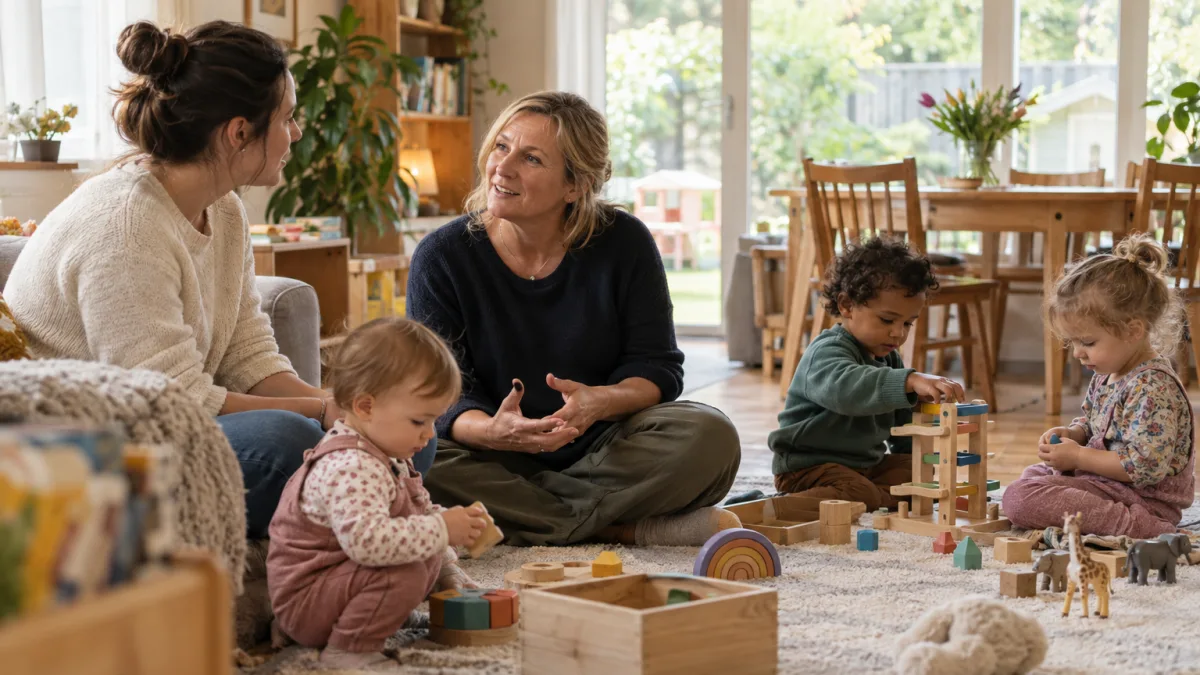
Choosing between a nursery and a childminder is not simply a choice between group care and care in somebody’s home. Both can provide warm relationships, early education, outdoor experiences and support for working families. The important differences usually involve the size of the setting, daily rhythm, number of carers and the way each option fits family life.
A nursery may offer long opening hours, several age-based rooms and a team of practitioners. A childminder normally cares for a smaller mixed-age group in a domestic setting and may offer a more flexible, home-like routine.
Neither option is automatically better for babies, toddlers or preschool children. A confident child may thrive in a busy nursery, but they could also enjoy the close relationships of a childminding group. A cautious child may prefer a smaller setting, yet settle beautifully in a nursery with a sensitive key person.
The best decision comes from comparing the actual providers available to you rather than choosing according to the label alone.
Nursery vs childminder at a glance
| Feature | Nursery | Childminder |
|---|---|---|
| Setting | Dedicated childcare premises, school or community setting | Usually the childminder’s home |
| Group size | Usually larger, often divided into age-based rooms | Usually a small, mixed-age group |
| Adults | A team of practitioners, including a key person for each child | Often one main carer, sometimes working with an assistant or co-childminder |
| Daily routine | Organised around nursery rooms, meals, sleep and group routines | Often more similar to family life and adaptable to the children present |
| Opening pattern | Commonly fixed sessions or full days | May be more flexible, but arrangements vary |
| Continuity | Other staff may provide cover when a practitioner is absent | Strong continuity with one carer, but fewer options if that person is unavailable |
| Age groups | Children may be separated into baby, toddler and preschool rooms | Different ages commonly spend much of the day together |
| Funded childcare | Many nurseries participate | Many childminders participate, but not all |
These are typical differences rather than strict rules. A small nursery may feel intimate, while a childminder working with assistants may care for a larger group. Opening hours, fees and routines must always be checked with the individual provider.
What is a nursery?
A day nursery provides early education and childcare in dedicated premises. It may be privately owned, operated by a charity, connected to an employer or part of a larger nursery group.
Many day nurseries accept children from babyhood until they start school. Children are often organised into rooms according to age or development, such as a baby room, toddler room and preschool room.
A nursery commonly employs a manager, room leaders and several early years practitioners. Each child should have a key person who takes particular responsibility for building a relationship, understanding their needs and communicating with the family.
Nurseries often open for a full working day and for most weeks of the year. They may provide breakfast, lunch, tea, snacks, naps, personal care and outdoor play within the child’s booked session.
Some settings called nurseries are school nursery classes or maintained nursery schools. These may operate during school hours and terms rather than following the year-round pattern of a private day nursery. Check the exact type of setting before comparing it with a childminder.
What is a childminder?
A childminder is a childcare professional who usually works from their own home. They may work alone, with an assistant or alongside another registered childminder.
The group is generally smaller than a nursery group and can include children of different ages. A baby may spend the day alongside a toddler and preschool child, with school-age children joining before or after school.
Childminding is not the same as informal babysitting. Registered childminders must meet the requirements that apply to their provision, including expectations around safeguarding, suitability, learning and development.
In England, registered childminders caring for young children generally follow the Early Years Foundation Stage, just as nurseries do. Registration and inspection arrangements differ across Scotland, Wales and Northern Ireland, so families should check the relevant national childcare regulator.
A childminder’s day may include play at home, walks, parks, libraries, toddler groups and school runs. Because the group is small, activities and routines may be adjusted around the children present.
How do the environments feel different?
A nursery normally has dedicated rooms, child-sized furniture and a range of resources available throughout the day. Larger settings may have sensory areas, sleep rooms, gardens and separate spaces for babies and older children.
This can offer variety and allow practitioners to design the environment for a particular developmental stage. A preschool room can provide challenges for older children without worrying that every resource must also be suitable for a crawling baby.
However, a larger nursery may feel busy. Children can experience more noise, movement and transitions between staff, rooms and routines.
A childminder’s home may feel more familiar and less institutional. Children might eat around a kitchen table, rest in a quieter room, accompany the childminder on everyday outings and build close relationships within a small group.
A home setting is not automatically calm, and a nursery is not automatically overwhelming. Visit during an ordinary childcare day if possible. Notice the noise level, available space, outdoor access and how comfortably children move around.
Also consider the practical features of a childminder’s home. Ask about stairs, pets, smoking, outdoor space, household members and where children eat, sleep and receive personal care.
Which provides more individual attention?
A childminder’s smaller group can allow them to know each child and family extremely well. The same adult may welcome the child, prepare meals, provide comfort, lead activities and share information at collection.
This continuity can be particularly valuable for babies and children who need time to trust unfamiliar adults. Siblings may also be cared for together despite being different ages.
Nurseries provide individual relationships through the key-person system, but children will normally interact with several practitioners. This can help them become comfortable with more than one adult and means another familiar member of staff may be available when the key person is absent.
Individual attention depends on more than the type of provision. Observe whether adults:
- Respond when a child communicates
- Notice small emotional and physical cues
- Join play without taking control
- Comfort children patiently
- Understand individual routines and preferences
- Speak warmly rather than only giving instructions
A small group does not guarantee responsive care, and a larger setting can still provide deeply attentive relationships.
How do routines and activities compare?
Nurseries often have a recognisable daily rhythm. Meals, outdoor play, stories and group experiences may happen at broadly planned times, although good provision should still respond to individual children.
Babies may follow personal feeding and sleep routines, while toddlers and preschool children gradually participate in more shared parts of the day.
A childminder can often adapt the routine around a smaller number of children. If a toddler needs an early nap or the group becomes absorbed in outdoor play, the day may be easier to adjust.
Childminders can also offer everyday community experiences. Trips to the library, local shops, playgroups and parks may form a regular part of the week.
Nurseries may offer a greater range of resources and activities without leaving the premises. Children may have access to large outdoor equipment, creative areas, construction materials and different group spaces.
More activities do not necessarily mean better learning. Young children benefit from time, responsive adults and opportunities to develop their own play. Ask what a normal day looks like rather than concentrating on a long list of special sessions.
Which option is better for social development?
Nurseries generally expose children to a larger peer group. This can provide frequent opportunities to observe others, form friendships, communicate, negotiate and participate in group routines.
Parents sometimes choose nursery because they believe a child must become accustomed to a large group before school. Group experience can be helpful, but a child does not need to spend every day among many children to develop social confidence.
A childminder’s smaller mixed-age group also supports valuable social learning. Younger children watch and imitate older ones, while older children practise patience and awareness of younger children’s needs.
Childminders may regularly meet other childminders or attend community groups, giving children opportunities to experience a larger gathering while retaining the security of their familiar carer.
Social development depends on the quality of the interactions. Watch how adults support sharing, disagreement and communication. Children do not learn social skills simply by being placed in the same room.
How do reliability and staff absence differ?
A nursery has a team of employees. If one practitioner is ill or on leave, the setting can often remain open by arranging suitable cover.
The disadvantage is that children may encounter staff changes. Agency workers, staff turnover or movement between rooms can affect continuity if not managed carefully.
A childminder may provide excellent consistency because the child spends most of their time with the same person. However, if that childminder becomes ill, attends training or takes annual leave, the setting may close.
Some childminders have assistants or reciprocal relationships with other local providers, but emergency cover is not automatic. Parents should ask:
- How much annual leave is normally taken?
- How much notice is provided?
- What happens if the childminder is ill?
- Are fees payable during closures?
- Is alternative care ever available?
Families without flexible work or nearby support may find nursery closure arrangements easier to manage. Others may accept the risk because they value the continuity of one main carer.
Which is more flexible for working families?
Childminders are often described as more flexible, and many do provide arrangements that nurseries cannot. A childminder may accept an earlier start, later collection, variable shifts or a combination of early years care and school runs.
However, flexibility depends entirely on the individual provider. Some childminders offer fixed full-day contracts and cannot accommodate changing hours because their limited places are already committed.
Nurseries usually have clearly defined sessions. A family may need to book a complete morning, afternoon or day even when it requires slightly fewer hours.
On the other hand, a nursery may open for longer each day and have more capacity to offer additional sessions when a parent’s schedule changes.
Compare the care you genuinely need:
- Earliest possible drop-off
- Latest collection time
- Required weekdays
- Term-time or year-round care
- Variable shift requirements
- School drop-off or collection for siblings
- Occasional extra sessions
Ask what happens if you are delayed. A childminder may need to begin a school run at a fixed time, while a nursery may apply a late fee but have staff remaining on site.
How do costs and funded childcare compare?
Fees vary by location, child’s age, attendance pattern and provider. It is not safe to assume that a childminder will always be cheaper than a nursery.
A nursery’s fee may include meals, snacks, nappies and activities, or these may be charged separately. A childminder may include almost everything in an hourly or daily rate, but another may charge for meals, outings and mileage.
Ask both providers for a written estimate based on the same schedule. It should explain:
- The basic hourly, session or daily charge
- Minimum booking requirements
- Charges for meals, consumables and outings
- Fees during the child’s absence
- Fees during the provider’s holiday or closure
- Deposit and registration arrangements
- Notice periods
- How funded hours are applied
Many nurseries and childminders offer funded childcare, but participation is not automatic. Confirm that the provider accepts the entitlement for your child’s age and has an appropriate funded place available.
Providers may offer the annual entitlement differently. A nursery might stretch it across 51 weeks, while a term-time childminder applies it over 38 weeks. The reverse could also be true.
Our guides to funded childcare eligibility and how 30 hours funded childcare works explain the main rules. You should still ask each provider for a personal cost illustration.
Compare the annual cost rather than looking only at the weekly figure. Include holiday care, provider closures, travel and any backup childcare you may need.
How might each option affect settling in?
A childminder’s small group and consistent adult can make the transition feel gentler for some children. The home-like environment may also seem more familiar to a baby or toddler.
A nursery may offer several settling visits, a dedicated key person and a range of activities that help a child become engaged after separation. Some children are quickly drawn into the busier environment.
The child’s response depends on the quality of the relationship and settling process, not simply the size of the setting.
Ask both providers:
- How many settling visits are offered?
- Can the parent remain during the first visit?
- Who will receive the child at drop-off?
- How will the child be comforted?
- When will the parent be contacted?
- How will updates be provided?
- Can sessions be lengthened gradually?
Settling may take days, weeks or longer. Tears at drop-off do not necessarily mean that the placement is unsuitable if the child accepts comfort and gradually begins participating.
Our guide on how long it can take a child to settle into nursery explains what progress may look like and when continued distress deserves further attention. Much of that guidance also applies when starting with a childminder.
What questions should you ask a nursery or childminder?
Use the same core questions for both types of provider so that the comparison remains fair.
- Who will care for my child during an ordinary day?
- What happens if that person is absent?
- How many children will be present, and what are their ages?
- What does a normal day look like?
- How are meals, naps and personal care managed?
- How often do children go outside?
- How do you support children who are upset?
- How will you share information with us?
- How do you support allergies, medical needs or SEND?
- Which funded childcare entitlements do you offer?
- What will our actual monthly and annual cost be?
- What happens during holidays, illness and closure?
- How much notice must we give to change or end the arrangement?
For a childminder, ask who else lives or regularly spends time in the home, whether there are pets and how school runs affect the younger children’s day.
For a nursery, ask about staff turnover, movement between rooms, use of temporary staff and how the key-person arrangement works during absence.
Read the latest inspection information where available, but do not allow a rating to replace your own questions and observations. The report reflects a particular point in time, and the day-to-day relationship must still suit your child.
How to decide which might suit your family
Begin by removing options that cannot meet your essential practical needs. There is little value in finding an ideal childminder who cannot cover your working hours or a beautiful nursery with no place on the days you require.
Then consider what feels most important for your child.
A nursery may suit your family if you value:
- Long and predictable opening hours
- Care across most of the year
- A team able to cover staff absence
- Dedicated rooms and a wide range of resources
- A larger peer group
- Age-specific spaces and routines
A childminder may suit your family if you value:
- A smaller, home-like environment
- One consistent main carer
- A mixed-age group
- Flexible routines and community outings
- Care for siblings of different ages together
- Potential flexibility around work or school hours
These lists describe possible advantages rather than guarantees. Judge the real nursery and real childminder in front of you.
Think about your own relationship with the provider as well. Can you ask questions comfortably? Do they listen without becoming defensive? Are fees and policies explained clearly? Good communication will matter long after the first visit.
Where possible, take time after each visit before deciding. The most visually impressive setting is not always the one in which interactions felt warmest or routines best matched your child.
Frequently asked questions
Is a childminder better than a nursery for a baby?
Not automatically. A baby may benefit from a childminder’s small group and consistent care, but a high-quality nursery baby room can also provide close, responsive relationships. Compare the carers, routines and environment.
Do childminders follow the same curriculum as nurseries?
In England, registered childminders caring for young children generally follow the Early Years Foundation Stage, as nurseries do. The learning may look different because it takes place in a smaller home and community environment.
Are childminders cheaper than nurseries?
They can be, but not always. Compare the complete cost, including meals, outings, funded hours, holidays, closures and any backup care required.
Can childminders offer 30 funded hours?
Many can, but not every childminder participates in the scheme or has a suitable funded place. Ask how the hours are scheduled and what additional charges remain.
Will my child socialise enough with a childminder?
A childminding group can provide meaningful relationships with children of different ages. Many childminders also attend playgroups, libraries, parks and activities where children meet a wider group.
Is nursery better preparation for school?
A nursery can provide experience of larger groups and shared routines, but a childminder can also develop communication, independence and confidence. School readiness depends more on the quality of care and learning than the provider type.
What happens when a childminder is ill?
The setting may need to close unless an appropriate alternative has been arranged. Ask about backup care, payment during closures and how much annual leave the childminder normally takes.
What happens when a nursery practitioner is ill?
The nursery can often arrange cover from its wider team. However, your child may be cared for by a less familiar practitioner, so ask how staffing changes are managed.
Can siblings attend the same childminder?
Often, yes. A childminder may care for a baby or preschool child during the day and collect an older sibling from school. Places and age-related limits will affect what is possible.
Can a child attend both nursery and a childminder?
Yes. Some families combine the two for flexibility or divide funded hours between providers. Both must understand the arrangement, and the total funded claim cannot exceed the child’s entitlement.
Which option has more flexible hours?
Childminders may be able to offer more individual flexibility, but this varies. Some nurseries open longer each day and can provide additional sessions more easily. Compare exact arrangements rather than assumptions.
How many settings should we visit?
There is no required number. Visit enough realistic options to understand what is available locally. Two thoughtful visits may be more useful than touring many providers that cannot meet your schedule or budget.
A nursery can offer the reliability of a larger team, extensive resources and a broad peer group. A childminder can provide a small, home-like environment and continuity with one main carer. Both can deliver excellent early education and secure relationships.
Start with the practical fit, then pay close attention to how adults respond to children. The provider that listens, communicates clearly and makes your child feel understood may suit your family better, regardless of which category it belongs to.